
Translation note: This article was originally written in Spanish and translated into English with the assistance of AI. I reviewed and edited the final version to preserve the original meaning and tone.
When we talk about the impact of artificial intelligence on work, we tend to ask the same question:
Which jobs will AI replace?
I think that question is too simplistic.
The most important transformation may not be which professions disappear, but how companies organize themselves when an increasingly large share of work can be performed by AI agents.
And this logic does not necessarily have to remain confined to digital work. As robotics brings similar capabilities into the physical world, this transformation could extend to a much larger share of the economy.
My hypothesis (and that of many others) is that we are entering a process of organizational pyramid compression.
Companies will still need people. They will still need engineers, designers, salespeople, managers, and executives…
But they may need fewer people to produce the same amount of work, especially at levels where work is more executable, repeatable, and verifiable. And that could have a much deeper consequence than simply increasing productivity:
AI could change the architecture of companies themselves.
The traditional pyramid
A traditional organization can be greatly simplified into four levels distributed across three layers: operational, functional, and business.
- At the base is the operational layer, where employees execute much of the work.
- The next tier is the functional layer, where managers coordinate people, resources, and objectives.
- Finally, there is the business layer, made up of the leaders of the company’s different functions and, at the very top, the CEO with ultimate responsibility for the organization.
We can simplify these four levels as follows:
- H1 — Employees: Execution and problem-solving within a relatively bounded domain.
- H2 — Management: Coordinating people, allocating resources, tracking progress, and prioritizing.
- H3 — C-Level: Leading the company’s different functions and making decisions with significant business impact.
- H4 — CEO: Vision, strategy, capital allocation, and ultimate responsibility for the organization.
As we move upward, we generally find fewer people and greater responsibility per person.

Artificial intelligence introduces a new variable into this structure.
An agent is not just another tool
For decades, we have increased worker productivity through software.
- A spreadsheet allows an accountant to perform calculations faster.
- An IDE allows a programmer to develop software more efficiently.
- Figma allows a designer to produce and modify interfaces much faster than previous tools.
But in all these cases, software was fundamentally a tool waiting for instructions. Planning and execution still fell primarily on the worker.
AI agents are beginning to break that relationship. An agent can receive an objective, explore a problem, use tools, produce an output, evaluate part of that output, and continue working.
We can even build complete processes involving multiple agents, where the output of one becomes the input of another. The difference may seem subtle, but organizationally it is ENORMOUS.
Traditional software increases a person’s execution capacity; agents are beginning to allow that person to delegate execution.
This difference can already be observed in real-world usage of programming tools. In an Anthropic analysis of 500,000 coding-related interactions, approximately 49% of interactions on Claude.ai were classified as automation. In Claude Code, designed specifically as a coding agent, that figure rose to 79%.1
We are not just talking about autocompleting a line of code. A significant share of those interactions involved delegating a task to the model and letting it work on it.
When you can delegate work to machines, the relationship between employee count and productive capacity begins to change.
Companies may no longer scale only by hiring people
Until now, growth at many companies followed roughly this relationship:
- More customers.
- More work.
- More employees.
- More managers.
- More coordination.
- More costs.
AI introduces another variable into the equation.
Instead of increasing capacity exclusively by adding people, an organization can also increase the artificial capacity available to the people it already has.
We are already beginning to see workers coordinating several agents simultaneously. In recent research on agentic programming tools, some users regularly work with multiple concurrent agents.
The unit of production therefore starts to look less like:
1 human
and more like:
1 human + N agents
This does not mean work disappears.
It means that some repetitive execution work can shift toward artificial systems.
And if one person can produce more, a company no longer needs to grow its workforce in direct proportion to its output.
Some companies are already explicitly experimenting with this idea.
Shopify, for example, made habitual AI use a baseline expectation internally and established that, before requesting additional headcount, teams should explain why the need could not be met using AI.2
The organizational question begins to change.
It used to be:
Who do we need to hire to do this?
Now it may increasingly become:
Do we need another person, or do we need to increase the capacity of the people we already have?
Management changes too
A large part of management today consists of:
- assigning work.
- collecting status updates.
- tracking progress.
- consolidating information.
- coordinating meetings.
- prioritizing tasks.
- identifying blockers.
- preparing reports.
- communicating upward and downward.
A surprising amount of that work consists of transforming, moving, and synthesizing information.
And that is precisely one of the areas where today’s models perform particularly well.
An agent can:
- summarize meetings.
- identify risks.
- update Jira, Notion, or Linear.
- generate documentation.
- track OKRs.
- prepare reports.
- answer internal questions.
- gather status updates across different projects.
This does not eliminate the need for management.
Managing people involves leadership, conflict, motivation, hiring, professional development, negotiation, and, above all, accountability.
But it can significantly reduce coordination overhead.
The manager’s value can progressively shift away from moving information and tasks toward interpreting context, resolving exceptions, and making decisions.
And if each manager can cover more, we need fewer layers dedicated exclusively to transmitting information between different parts of the organization.
In fact, we are already seeing signals consistent with this phenomenon.
SignalFire’s State of Tech Talent 2026 finds that engineering managers at major technology companies now manage around 12 engineers on average, compared with 10 previously. At early-stage startups, the ratio is around 15.3
Product Managers at the major technology companies analyzed by SignalFire are also supporting approximately 22% more engineers than in 2019.3
AI is not the only explanation. The correction following years of overhiring, macroeconomic conditions, and changes across the industry also matter.
But the direction is interesting:
greater individual capacity → wider span of control → potentially flatter organizations.
It could also change how companies organize around departments
A typical digital company may have areas such as:
- Marketing.
- Design.
- Engineering.
- QA.
- Data.
- Product.
Although we separate them into departments, they all operate along the same value-creation flow.
With specialized agents, we can imagine increasingly continuous processes:
Idea → Research Agent → Business Agent → Product Agent → UX Agent → Design Agent → Frontend Agent → Backend Agent → QA Agent → Deployment Agent → Growth Agent
This does not necessarily mean Product, Design, or Engineering disappear.
It means that an increasing share of the work flowing between those functions can be performed automatically.
Humans intervene where they provide judgment: setting objectives, providing context, evaluating results, resolving exceptions, and deciding what should happen next.
And this leads to one of the changes I consider most important.
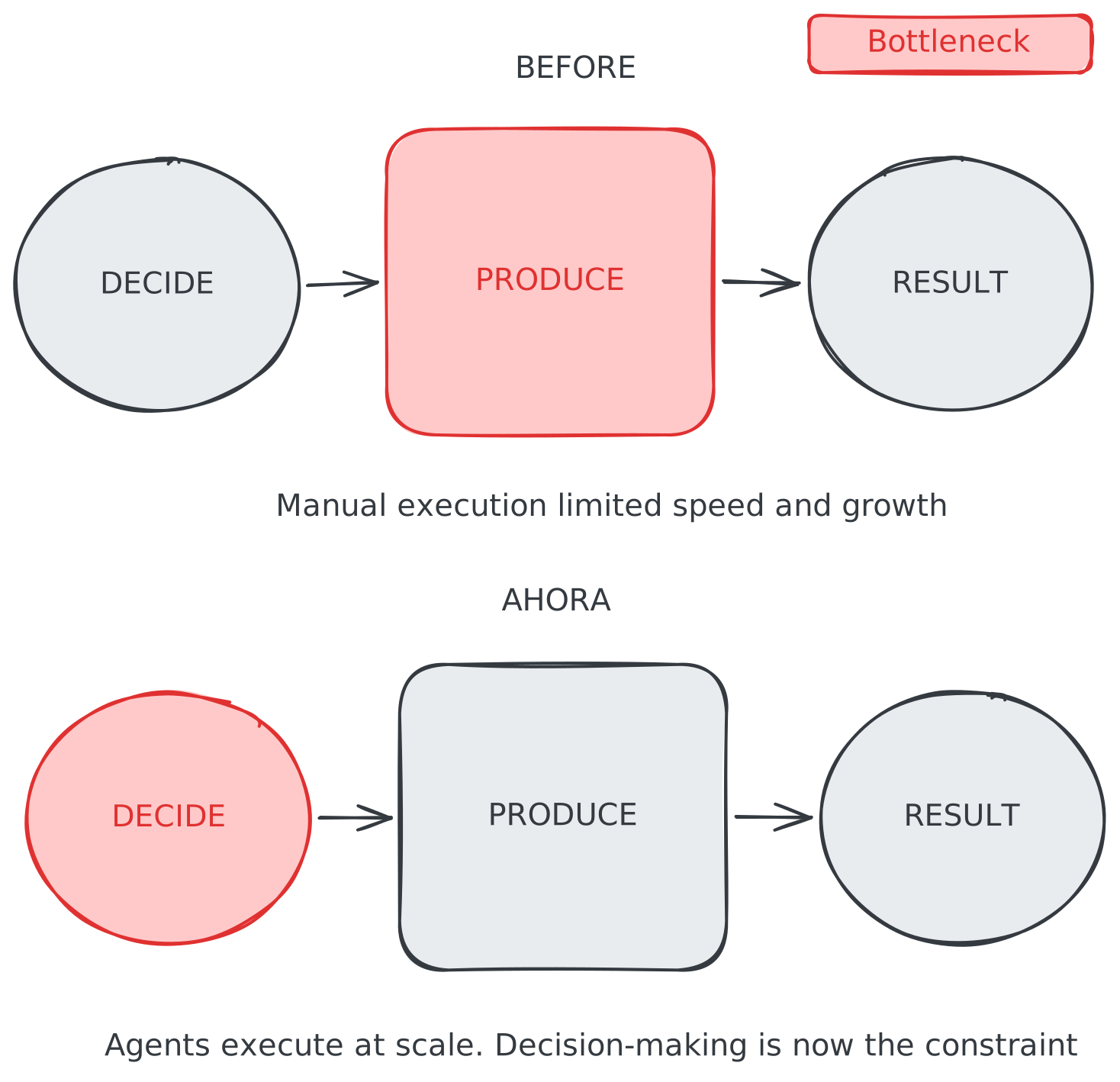
The bottleneck shifts
For decades:
- Production was expensive.
- Writing software was expensive.
- Design was expensive.
- Analyzing information was expensive.
- Creating content was expensive.
- Preparing presentations was expensive.
All of these things still have a cost, but AI is dramatically reducing the marginal cost of many of these activities. The bottleneck begins to shift from producing to deciding.
- What do we build?
- Which market do we target?
- Which hypothesis do we test?
- What do we launch?
- What do we kill?
- What do we prioritize?
AI can dramatically reduce the cost of producing an answer. It does not necessarily reduce the cost of asking the right question.
Small companies gain leverage
All of this can dramatically increase the power of small organizations.
A five-person startup equipped with good AI systems can aspire to a level of productive capacity that only a few years ago would have required a considerably larger team.
We do not need to assume a literal equivalence of “5 people = 50 people.” The ratio will vary enormously depending on the business and the type of work.
What matters is the mechanism:
headcount and productive capacity begin to decouple.
Klarna offers an interesting example.
Between 2022 and 2025, its annual revenue per employee increased from approximately $344,000 to $1.24 million. The company itself has linked part of its efficiency gains to AI adoption, a reduction in external vendors, and the use of AI tools across the organization.4
This does not prove that AI was responsible for all of that improvement.
But it does illustrate the kind of organization many companies are trying to build:
more output and more revenue without proportionally increasing the number of employees.
PwC found a similar pattern at an aggregate level when analyzing close to one billion job postings: industries with greater AI exposure showed substantially higher revenue-per-employee growth than less exposed industries.5
If this trend continues, competing as a small company could become much easier.
And that could introduce new players into markets that historically required considerably more human capital.
Building software is no longer enough
For decades, the ability to build technology was itself a considerable barrier to entry.
If the cost of producing software continues to fall, that barrier falls with it.
Software does not stop being the product in a SaaS business.
But building software may stop being, by itself, a sufficient competitive advantage.
Value shifts toward what is harder to replicate:
- data.
- distribution.
- brand.
- community.
- processes.
- internal knowledge.
- customer knowledge.
Above all, the hardest part — the judgment required to decide what to build:
- Two companies may have access to similar models.
- Both may be able to generate code quickly.
- Both may be able to analyze millions of documents.
- Both may be able to produce campaigns in minutes.
The difference will be what they decide to do with that capacity.
The emergence of AI-first companies
An AI-first company is not a company that pays for Claude, ChatGPT, or whichever LLM is popular at the time for all of its employees.
It means designing the organization on the assumption that agents exist from day one.
Just as a cloud-native startup does not design its infrastructure as if it had to install physical servers in a room, an AI-first company does not design all of its processes on the assumption that every step must be performed manually by a person.
First, it designs the system.
Then it decides where human intervention is needed.
This requires something quite different from a chatbot or a copilot.
We are beginning to see genuine business operating systems containing:
- memory.
- objectives.
- context.
- metrics.
- agents.
- knowledge.
- processes.
- tools.
- permissions.
Microsoft uses an interesting concept to describe this evolution: the Frontier Firm, organizations built around teams of humans and agents.6
It even proposes thinking about a new metric: the human-agent ratio.6
How many humans does a particular function need?
How many agents?
And what should the relationship between the two look like?
That is exactly the kind of question an AI-first organization will increasingly have to answer.
A company stops being exclusively a collection of people using tools.
It becomes a collection of humans and agents collaborating around the same knowledge base and the same objectives.
We can summarize the evolution like this:
- Traditional company: Human → Software.
- AI-assisted company: Human → Copilot → Software.
- AI-native company: Human → Orchestrator → Agent network → Software.
The revolution here is not simply about automating tasks.
It is about changing the architecture of the company.
Simply saying that “AI will make employees more productive” falls short.
Productivity is the consequence.
The truly interesting change is in how work is organized, how decisions are made, and how an organization scales.
And with all of this in mind, we arrive at my hypothesis.
Organizational pyramid compression
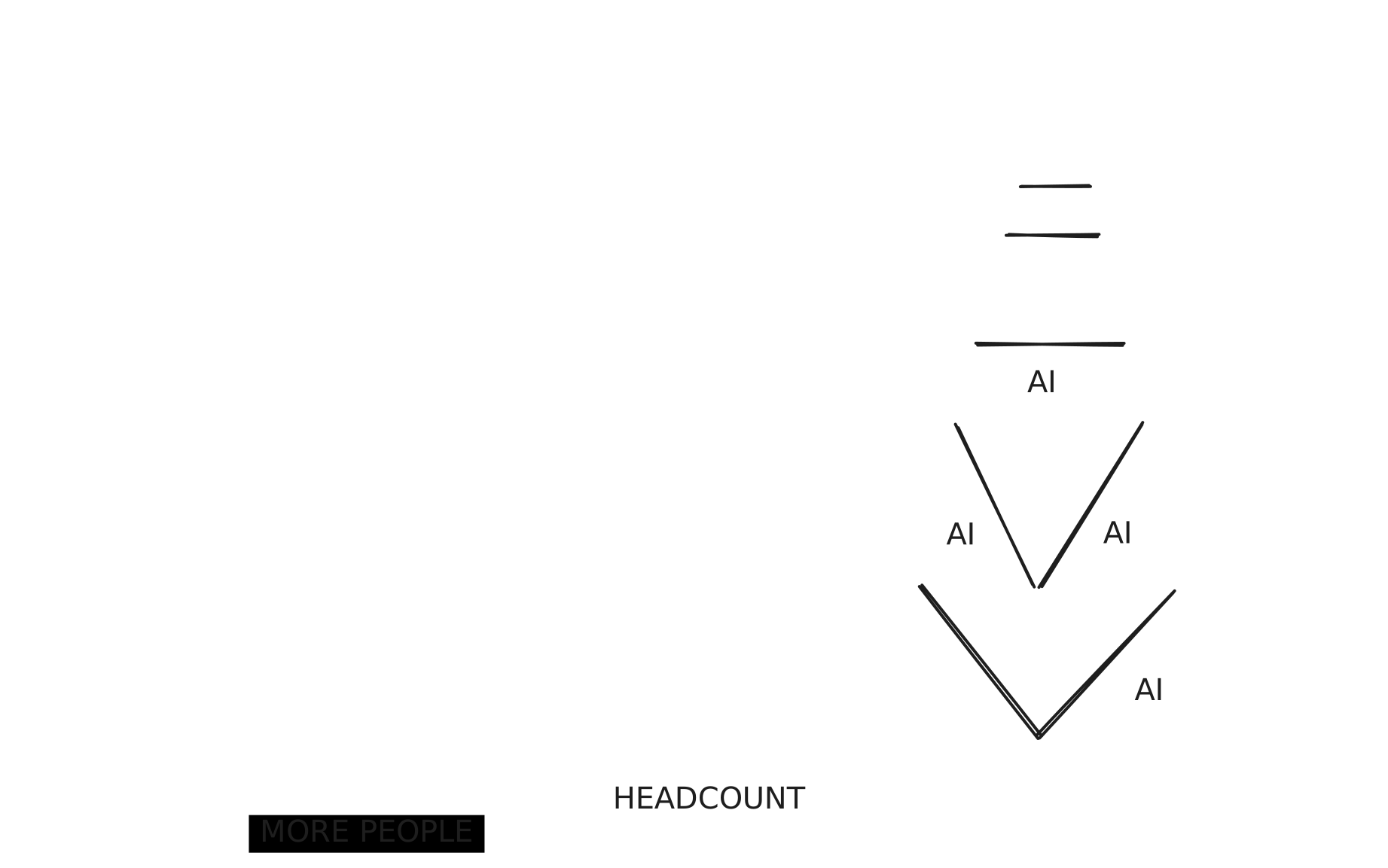
Imagine that every level of the company begins to have access to specialized agents.
- An engineer can delegate parts of implementation, testing, documentation, or research.
- A manager can automate tracking, reporting, context gathering, or blocker detection.
- An executive can use agents to analyze metrics, study markets, model scenarios, or prepare strategic alternatives.
- A CEO can have systems continuously monitoring finance, competitors, operations, customers, and risks.
AI appears at every level.
But its effect does not have to be the same at every level.
The more structured, repeatable, and verifiable a task is, the greater our ability to delegate it.
We can also think about a second dimension independent of hierarchy: Execution → Coordination → Strategy
- Execution includes tasks such as programming, producing designs, generating documentation, or creating assets.
- Coordination includes planning, assignment, tracking, and information synthesis.
- Strategy contains decisions where uncertainty, impact, and accountability increase.
My hypothesis is that AI progressively shifts human work toward the end of the spectrum with greater judgment and responsibility.
This does not mean an employee (H1) only executes, or that a CEO (H4) only designs strategy. It means that as artificial capacity absorbs execution and part of coordination, the relative value of human work devoted to understanding, supervising, and deciding increases.
And this particularly affects roles at the base of the pyramid.
The problem with entry-level roles
Software development is one of the places where this tension is becoming particularly visible.
Traditionally, hiring a junior profile made fairly clear economic sense. The company gained relatively inexpensive execution capacity in exchange for accepting lower initial productivity and bearing the cost of training that person:
- The junior solved simple tasks.
- More experienced people reviewed their work.
- Over time, they acquired context, judgment, and autonomy.
But coding agents are beginning to compete precisely in part of that space. They can implement bounded tasks, write tests, find bugs, modify existing code, generate documentation, or explore a codebase. And they have very different economic characteristics from an employee:
- They do not require a hiring process.
- They do not leave the company six months later.
- They do not require salary progression or a career plan.
- They do not have working hours.
- And on top of that, the marginal cost of providing more inference capacity continues to fall.
This does not mean that an agent is equivalent to a junior developer. Nor am I arguing for a simple AI → human substitution. I am talking about amplification:
AI executes. The human decides.
AI produces options. The human approves, rejects, or reframes them.
An employee learns the business, develops judgment, builds relationships, identifies problems nobody asked them to look for, and can eventually become a senior engineer, staff engineer, or CTO.
An agent does not represent that same kind of human asset today.
But for certain tasks, an uncomfortable economic comparison emerges:
Do I hire another person to increase execution capacity, or do I give the people I already have more AI capacity?
I think more and more companies are going to ask themselves that question.
And it is not limited to programming.
We can ask it in design, marketing, finance, legal, human resources, and practically any information-intensive function.
And we’re already seeing signals among junior workers
This is where the hypothesis begins to intersect with particularly interesting data.
Recent research from the Stanford Digital Economy Lab using labor-market data from millions of US workers has found a particularly sharp decline in employment among young workers in occupations highly exposed to AI.
For workers aged 22 to 25 in the most exposed occupations, employment was approximately 19% below the trajectory of less-exposed occupations.7
More interesting still, the pattern appears to be concentrated particularly in lower hiring of young workers, rather than simply mass layoffs.
SignalFire finds something similar within the technology industry.
Compared with 2019, new-graduate hiring appears to have fallen by approximately 65% at major technology companies and 76% at early-stage startups.3
That does not prove that AI is solely responsible.
Interest rates, pandemic-era overhiring, market corrections, and other variables matter enormously.
But it is consistent with one of the predictions of this thesis:
Compression may begin not by massively firing the base of the pyramid, but by expanding it more slowly.
The entry bar may rise
This may be one of the less-discussed consequences of the AI revolution.
For years, we have assumed that a career begins by learning to execute relatively simple tasks.
First you do.
Then you understand.
Eventually you decide.
AI may absorb precisely part of that first rung.
That does not necessarily imply the disappearance of junior roles.
It may mean something different:
The minimum level required to create value rises.
The junior of the future may be expected, from day one, to do things that we previously expected from someone with considerably more experience.
Not because they magically know more engineering.
But because they will have agents providing them with much greater execution capacity and, at the same time, a support network.
The differentiating skill gradually stops being simply doing the task.
It becomes knowing:
- which task should be done.
- how to break down a problem.
- what context the AI needs.
- when the output is wrong.
- what risks exist.
- which solution fits the system.
- when to intervene.
- and when to completely ignore what the model proposes.
In other words, judgment becomes more valuable.
From execution to supervision
This could gradually shift human work toward higher levels of responsibility.
Not necessarily toward management positions.
Toward higher levels of responsibility within each profession.
This transition is already beginning to show up in real-world use of coding agents. In an analysis of approximately 400,000 Claude Code sessions, Anthropic found that humans made most planning decisions, while Claude made most execution-related decisions.8
The pattern fits precisely with the shift described here: AI absorbs a growing share of execution while humans retain a greater share of planning, supervision, and decision-making.
- Engineers spend less time writing every line and more time on architecture, product, and review.
- Designers spend less time producing variations and more time deciding what experience should exist.
- Marketing specialists spend less time generating assets and more time deciding which message, audience, and experiment make sense.
- Managers spend less time gathering information and more time resolving exceptions, developing people, and making decisions.
AI executes a larger share of the work.
Humans decide over a larger share of the system.
One person starts to look like a small team
Until now, we have thought about an organization’s capacity roughly in terms of headcount.
Need to develop faster? Hire.
Need to produce more content? Hire.
Need more product capacity? Hire.
AI introduces a new way to increase capacity.
A worker can have several agents working simultaneously:
- one researches.
- another implements.
- another analyzes.
- another tests.
- another monitors.
The human stops being only an individual producer and begins to become, in part, an orchestrator of artificial capacity.
The productive unit starts to look less like:
1 human
and more like:
1 human + N agents
Microsoft even uses the term Agent Boss to describe this new role: workers who build, delegate to, and manage agents as part of their everyday work.9
This could allow relatively small organizations to produce results that historically would have required much larger teams.
What happens to management?
This is where the thesis becomes especially interesting.
A large part of modern management exists because coordinating human beings is expensive.
Information has to be transmitted, status updates collected, dependencies resolved, work assigned, blockers identified, reports prepared, meetings held, and communication moved up and down the organization.
A considerable amount of that work consists of transforming, moving, and synthesizing information.
Its individual value may be relatively low, and that is precisely one of the areas where current models perform particularly well.
If we reduce that overhead, a manager can supervise larger systems.
And if each manager can cover more, the organization may need fewer intermediate layers.
The pyramid compresses again.
Not necessarily because people are “redundant.”
But because each leader can coordinate a greater amount of work with the help of AI systems.
A company could conceptually move from something like:
CEO
 │
5 directors
 │
40 managers
 │
300 employees
to:
CEO
 │
2 directors
 │
8 managers
 │
120 specialists
The numbers are deliberately illustrative; they are not intended as forecasts of future ratios.
The numbers are not the point.
The shape is.
The pyramid narrows and flattens.
The higher you go, the more accountability matters
There is, however, a reason why I do not think this pyramid simply disappears.
Capability and accountability are not the same thing.
- An AI can produce a financial analysis. Someone still has to decide whether to invest ten million euros.
- It can recommend shutting down a product line. Someone has to own the consequences.
- It can generate a strategy. Someone has to bet the company on it.
As we move upward through an organization, the cost of being wrong increases, while the ability to objectively verify a decision before making it decreases.
Some problems have a correct answer.
Others contain only uncertainty.
I think humans will retain a central role for quite some time precisely where these three things converge:
uncertainty + impact + accountability
AI can provide extraordinarily good information.
But someone has to decide.
The big problem: where do seniors come from?
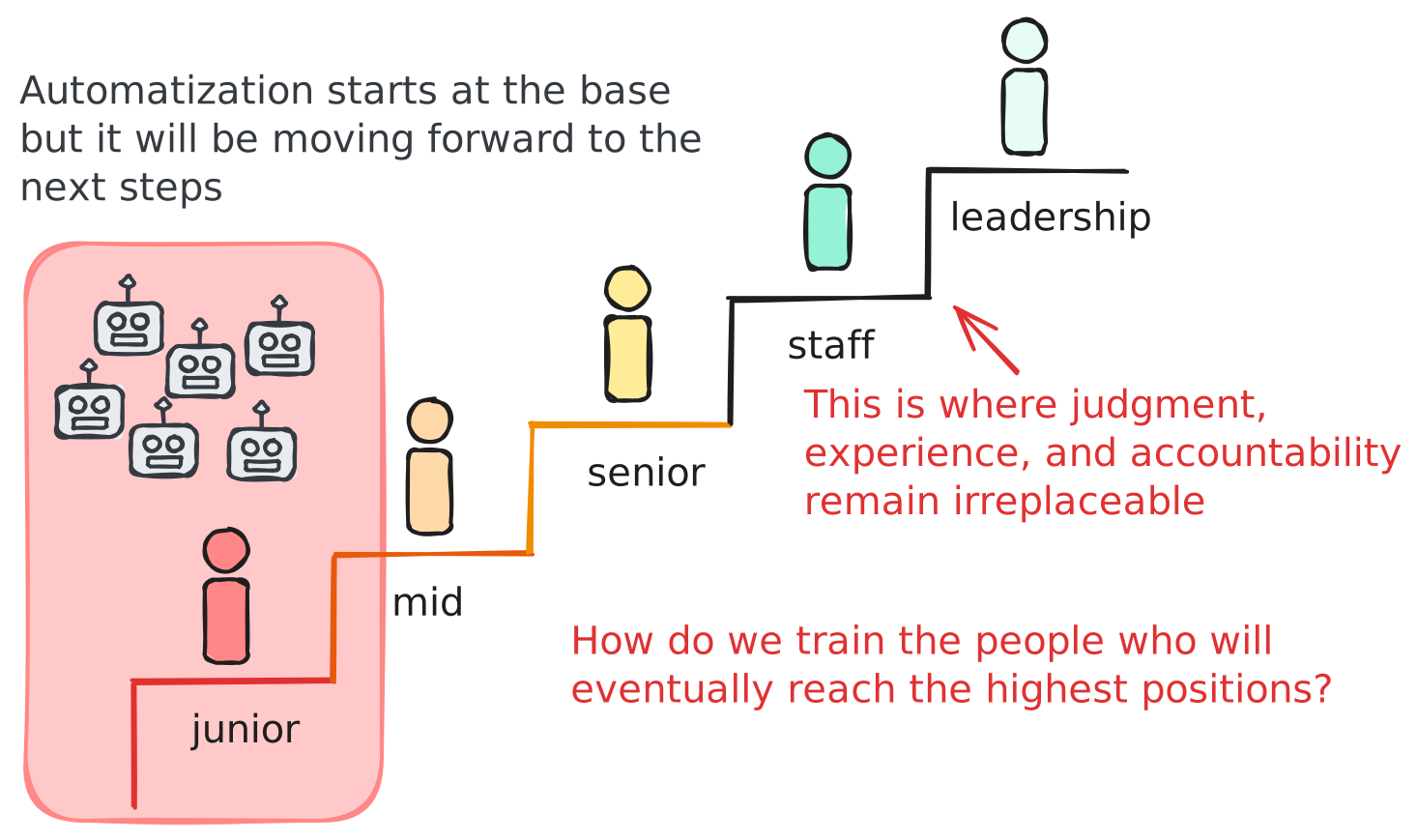
This is where an important contradiction appears in the thesis.
If we reduce junior roles because AI can execute some of the work we historically used to bring people into a profession…
how do we produce the seniors we will need ten years from now?
We are not born with judgment.
We develop it by solving problems.
By making mistakes.
By watching systems break.
By working with people who are better than us.
By making small decisions before making big ones.
And here a paradox emerges:
AI may automate precisely some of the work through which we learned to perform more complex work.
A company can save money by not hiring juniors today and discover a decade from now that it has destroyed its own talent pipeline.
That is why I do not think the answer is simply to eliminate entry-level roles.
I think we will have to redesign them.
Perhaps professional learning will rely less on spending several years producing simple work and instead use AI as an accelerator for training.
A junior with agents could encounter more complex problems earlier, explore alternatives, receive immediate feedback, and work on systems that were previously reserved for more experienced profiles.
The question then stops being how to artificially preserve work that AI can perform.
The interesting question is:
How do we teach judgment when execution is no longer the bottleneck?
I think this may end up being one of the most important labor-market questions of the next decade.
But more AI does not automatically mean more productivity
There is an obvious temptation in this argument.
To assume that introducing agents automatically means producing more.
It does not.
METR conducted a controlled experiment with experienced developers working on repositories they knew well.10
With the AI tools available at the time of the study, developers took approximately 19% longer when they were allowed to use AI.10
What is especially interesting is that they believed they had been faster.
That is an important warning.
Agents also introduce:
- supervision costs.
- errors.
- incorrect context.
- security issues.
- outputs that look correct but are not.
- and new forms of technical debt.
METR has since said that newer tools likely provide greater productivity improvements than those evaluated in the original experiment, although selection effects in subsequent studies prevent a reliable estimate of the size of that improvement.11
Organizational compression only happens when artificial capacity actually substitutes for execution or coordination capacity.
Installing a chatbot for every employee does not automatically make a company AI-first.
This will not happen equally everywhere
This is a hypothesis, not an economic law.
Not every company can automate the same amount of work.
Not every profession has outputs that are easy to verify.
Not every agent is reliable enough.
And issues around security, regulation, privacy, accountability, and trust can dramatically slow this transformation.
Nor do I think organizations will simply replace people with AI according to some fixed ratio.
We will probably see many different configurations:
- companies that use AI to grow without increasing headcount.
- companies that reduce certain functions.
- companies that keep the same number of workers but multiply their output.
- companies where AI adds little value or even creates more overhead.
- and companies that use productivity gains to do things that were previously not economically viable at all.
The important thing is not to predict exactly how many jobs will disappear.
It is to understand that the relationship between work, headcount, and output is changing.
My prediction
I do not think the immediate future is a company without people.
Nor do I think that tomorrow we will have CEOs running gigantic companies through fully autonomous armies of agents.
At least not yet.
My bet is considerably less spectacular and, precisely for that reason, potentially much more important.
- Digital companies will be smaller for the same productive capacity.
- Less human work will be devoted exclusively to execution.
- Entry-level roles will demand more capability from the beginning.
- Managers will be able to cover more.
- Some coordination layers will shrink.
- Specialists will work with small teams of agents.
- A growing share of human value will shift from execution toward understanding, supervising, deciding, and taking responsibility.
It will not be humans versus AI.
It will be humans + AI.
But that does not mean nothing changes.
It means precisely the opposite.
When each person can do work that once required several people, the company designed around those people has to change too.
👉 Do you think AI will compress the organizational pyramid?
Perhaps a few years from now, the important question will not be how many jobs artificial intelligence has replaced, but how many people a company needs to produce the same amount of value.
My hypothesis is that we will see smaller organizations, less purely human execution, more demanding entry-level roles, and people managing increasingly large amounts of capacity through AI agents.
But this creates an important contradiction: if we automate the first rungs of a career, we will have to find a new way to train the people who will one day occupy the highest ones.
I think that is one of the most interesting conversations we will have over the coming years.
What do you think? Are we simply looking at another productivity tool, or will AI actually change the architecture of companies?
Share your thoughts in the comments. I am especially interested in arguments against this thesis and examples of organizations where this is already happening. 🚀
Footnotes
-
Data from Anthropic Economic Index — AI’s impact on software development, based on an analysis of 500,000 programming interactions across Claude.ai and Claude Code. ↩
-
Shopify’s AI-first hiring policy as reported in Shopify CEO tells teams to consider using AI before growing headcount. Tobi Lütke established that teams should demonstrate why a need could not be met using AI before requesting additional headcount. ↩
-
Data from SignalFire — State of Tech Talent Report 2026, which analyzes hiring, seniority, management layers, and spans of control across major technology companies and startups. ↩ ↩2 ↩3
-
Financial data from the Klarna Group 2025 Annual Report filed with the SEC. Klarna reports an increase in average annual revenue per employee from approximately $344,000 in 2022 to $1.24 million in 2025 and links part of its efficiency improvements to AI adoption. ↩
-
Data from PwC — 2025 Global AI Jobs Barometer, based on an analysis of close to one billion job postings. PwC found that the most AI-exposed industries recorded substantially stronger revenue-per-employee growth than the least exposed industries. ↩
-
The Frontier Firm and human-agent ratio concepts come from Microsoft 2025 Work Trend Index — The Year the Frontier Firm Is Born, based on data from 31,000 workers across 31 countries, LinkedIn labor-market trends, and Microsoft 365 usage signals. ↩ ↩2
-
Data from the Stanford Digital Economy Lab — Canaries in the Coal Mine? Six Facts about the Recent Employment Effects of Artificial Intelligence, August 2026 revision based on ADP administrative data covering millions of US workers through June 2026. ↩
-
Additional evidence on human-agent work from Anthropic — Agentic coding and persistent returns to expertise, based on approximately 400,000 Claude Code sessions between October 2025 and April 2026. The study finds that humans make most planning decisions while Claude makes most execution decisions. ↩
-
The Agent Boss concept comes from Microsoft WorkLab — How to Be an Agent Boss, where it is used to describe a person who builds, delegates to, and manages AI agents. ↩
-
Counterevidence from METR’s study Measuring the Impact of Early-2025 AI on Experienced Open-Source Developer Productivity. In the controlled experiment, experienced developers took 19% longer when using the AI tools evaluated, despite believing they had been faster. ↩ ↩2
-
Follow-up from METR in We are Changing our Developer Productivity Experiment Design. METR sees signals consistent with productivity improvements from newer tools, but warns that selection effects prevent a reliable estimate of the size of the improvement. ↩